Wednesday, October 24, 2012

Monday, October 1, 2012
GRAPHIC: Dissection of hoof with impacted bars
I did not do this dissection, I found them posted on one of the list serves I follow. I wanted to show you these because it's one of the best dissections I've seen that show impacted bars in a horse hoof.
For any of you that may think I go on like a broken record about trimming the bars, or for any Ramey/ less-is-more followers who happen to stumble across this blog, this hoof shows what could happen when the bars are left to grow unchecked.
 The side view and x-ray for reference. This is obviously a founder, I would say a completely avoidable one if only the bars had been trimmed.
 Everything under the pink area (digital cushion, corium, later cartilages, deep digital flexor tendon) is bar. Look at how they've squeezed the soft tissues into an incredibly small, tight space. How could the hoof possibly function normally when it's been squeezed like that? Can you also see how bars that have impacted like these will damage the DDFT where it travels around the navicular bone and connects to the coffin bone?
 Yet another view showing just how tall the bars have gotten. That's almost 2 inches of bar!
 I think this one is interesting. Even though the walls are probably only a half inch too long (keeping in mind the dead material over the sole), the bars are at least an inch-and-a-half too long! Somebody was obviously trimming the peripheral walls down on this horse but they probably didn't touch the bars for years, if ever- and the horse suffered for it.
Here's a refresher: The bars are part of the hoof wall. Just like the rest of the wall they are composed of an outer wall, an inner wall, and laminae. Since they are part of the wall they grow at the exact same rate as the rest of the wall and should be trimmed in like fashion. Horses don't grow bar over sole and around the frog because "the hoof needs it," that's a garbage statement. If they are not trimmed they have to go somewhere, so they either grow up into the hoof like on this horse (hello navicular and founder) or out over the sole (which will create underrun hooves in no time). If you do trim the bar and it pops back out, that again isn't proof that the "hoof needs it" because cell division doesn't work that way, what that proves is that the bar inside the hoof finally had some room to move out.
Someday I'll let this subject go, but as long as there are people parroting misinformation about the bars I can't. So long as there are hooves like this out there I can't. This horse could have been saved if only someone had trimmed those bars.
For any of you that may think I go on like a broken record about trimming the bars, or for any Ramey/ less-is-more followers who happen to stumble across this blog, this hoof shows what could happen when the bars are left to grow unchecked.


Someday I'll let this subject go, but as long as there are people parroting misinformation about the bars I can't. So long as there are hooves like this out there I can't. This horse could have been saved if only someone had trimmed those bars.
Tuesday, September 11, 2012
Hoof angles
I was inspired to do this post by Kristen over at Sweet Horse's Breath, she asked about hoof angles which is something I have an opinion about (of course, right?).
I realized that I've posted a lot of sole shots of the Quarters' hooves but I haven't shown much of the top side. The reason for that is I believe if the sole of a hoof looks good then the top of the hoof usually looks pretty good too. But it has finally occurred to me that most people look at the casing of the hoof instead of the sole- and that's where the angles come in.
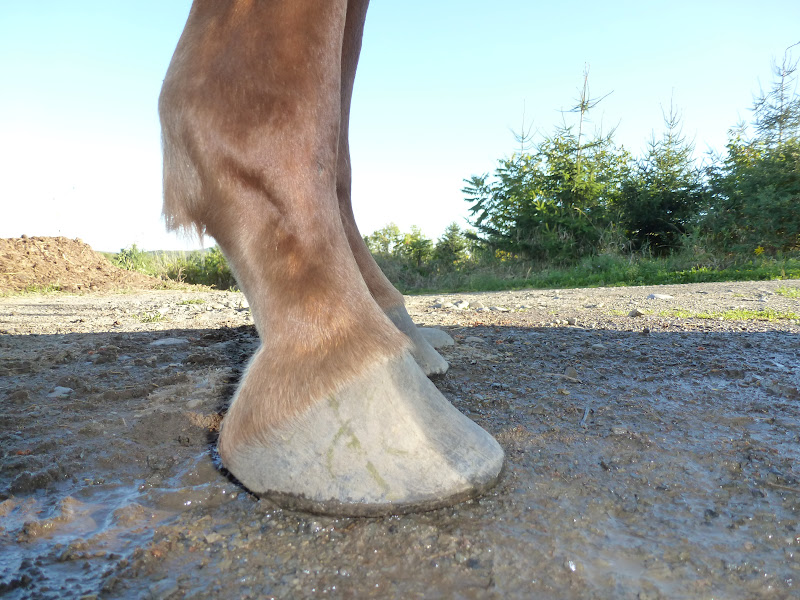
There's only one angle in the hoof that I really care about- the hairline angle. It should be around 30 degrees from the ground and it should be straight. If it's horizontal to the ground, curved around the heel, or is lumpy and bumpy you've got problems. If the hairline angle is around 30 degrees, you can be reasonably assured that the coffin bone is in the correct position inside the hoof.
I care very little about the toe angle. I know that many farriers go on about how the toe should always be around 55 degrees, but I don't go for that -because the toe LIES. If there's any degree of separation in the lamina that toe will stretch and the angle will grow shallow. If all you're looking at is that angle you end up letting the heels get higher and higher as you try to keep that angle at the toe. If you do that for long enough you end up with a lame horse at best and a foundered one at worst.
I feel about the same about the heel angle. If the heel is underrun the hairline angle will tell you anyway. If the heel is too high, the hairline angle will tell you that too.
Anyway, time to put my money where my mouth is:
Keep in mind that my horses have classic hi/lo front feet because they have terrible posture. They both stand with the left fore back that makes it clubby and the right foot forward which makes it want to splay out. Hopefully as I get further along in their training, lateral work will take care of this problem.
Are they perfect? No. Because of the crazy weather we've had the grass sugars have been all over the place, we had an especially bad spike this spring and many horses had acute laminitis attacks because of it. Fortunately, neither one of my horses was lame from it but they were still affected.
Despite that, Coriander is trot-on-gravel sound and Gwen has never acknowledged the existence of gravel. She has Chuck Norris hooves: She doesn't need to watch out for rocks, rocks need to watch out for her.
Thoughts? Questions? Concerns?
I realized that I've posted a lot of sole shots of the Quarters' hooves but I haven't shown much of the top side. The reason for that is I believe if the sole of a hoof looks good then the top of the hoof usually looks pretty good too. But it has finally occurred to me that most people look at the casing of the hoof instead of the sole- and that's where the angles come in.
There's only one angle in the hoof that I really care about- the hairline angle. It should be around 30 degrees from the ground and it should be straight. If it's horizontal to the ground, curved around the heel, or is lumpy and bumpy you've got problems. If the hairline angle is around 30 degrees, you can be reasonably assured that the coffin bone is in the correct position inside the hoof.
I care very little about the toe angle. I know that many farriers go on about how the toe should always be around 55 degrees, but I don't go for that -because the toe LIES. If there's any degree of separation in the lamina that toe will stretch and the angle will grow shallow. If all you're looking at is that angle you end up letting the heels get higher and higher as you try to keep that angle at the toe. If you do that for long enough you end up with a lame horse at best and a foundered one at worst.
I feel about the same about the heel angle. If the heel is underrun the hairline angle will tell you anyway. If the heel is too high, the hairline angle will tell you that too.
Anyway, time to put my money where my mouth is:
 |
| Gwen's left fore |
 |
| Gwen's right fore |
 |
| Gwen's left hind |
 |
| Gwen's right hind |
 |
| Coriander left fore |
 |
| Coriander right fore |
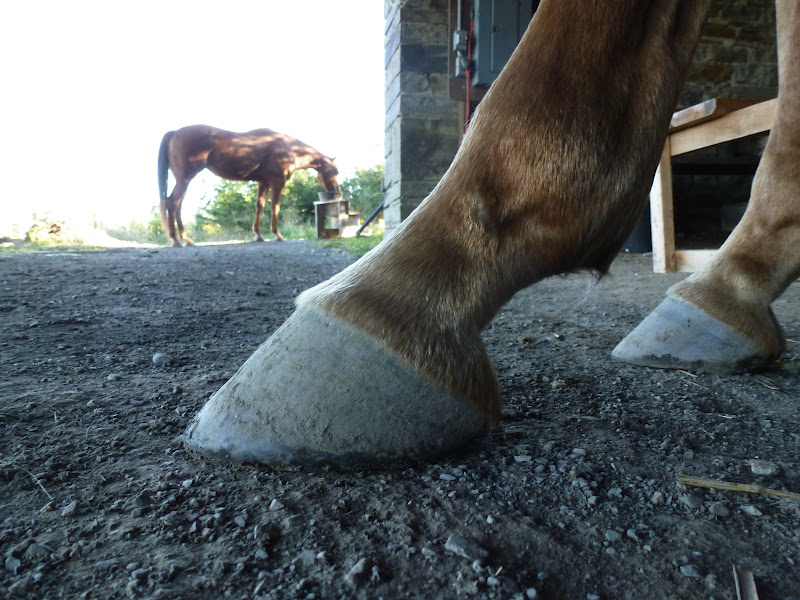 |
| Coriander left hind |
 |
| Coriander right hind |
Despite that, Coriander is trot-on-gravel sound and Gwen has never acknowledged the existence of gravel. She has Chuck Norris hooves: She doesn't need to watch out for rocks, rocks need to watch out for her.
Thoughts? Questions? Concerns?
Wednesday, August 29, 2012
This is how hooves should be trimmed
(In my opinion)
James Welz posted a video of his trim on YouTube, I encourage you to take a look at this video before he changes his mind and takes it off. I've been doing this trim since February and have seen many positive changes in the Quarter's hooves.
James Welz posted a video of his trim on YouTube, I encourage you to take a look at this video before he changes his mind and takes it off. I've been doing this trim since February and have seen many positive changes in the Quarter's hooves.
Tuesday, August 21, 2012


Wednesday, August 15, 2012
Gwen's choice
I haven't been able to do much with my horses lately, as you might have ascertained by my lack of posts. Other aspects of my life have crowded into my horse time, add to the very swollen left knee that my handsome boy seems to have acquired and I haven't had much to talk about that wasn't depressing. Summer of maladies, 2012.
Gwen, it would seem, does not appreciate the fact that I'm "ignoring" her. She came up to me yesterday after eating her dinner and said, "I want to do something." Well it's hard to argue with that. I dug out her mat (a piece of plywood), put it on the ground and waited for her to put her feet on it. Mind you she wasn't wearing a halter or anything, so there was no way I could direct her to stand on the mat besides body language and her memory of what the mat means.
For those of you who may not know, standing on a mat is a foundation clicker training exercise. Horse get a high rate of reinforcement for placing both front feet squarely on the mat. It teaches impulse control and how to ground-tie. For many horses who really love standing on the mat you can use it to help a horse get comfortable in the "scary corner" of arenas or trailers or trails. It's a very handy exercise.
So there we were, looking down at the mat when Gwennie did what she normally does at first sight of the mat (which btw is not good) and pawed at it. Normally I back her up or step her forward to approach the mat again when she does this, but without a halter I couldn't do that. Fortunately this wooden mat doesn't stay put when she paws, it skates over the ground- which doesn't get her rewarded. So she tried that a couple times before her lightbulb went off and she planted one foot squarely on the mat. Reward!
Then I waited. "You have to put the other foot on it, babe," I said, pointing to it. Up went the other foot, plopped down squarely next to the first. Reward, reward, reward! I then slowly walked around her, rewarding her for remaining still when I left her head. At one point, she fidgeted and a hoof came off the mat. No reward for that, so I walked a few feet in front of her and asked her to target on my fist. She came off the mat to my hand for her reward and I figured that would be the end of it- that she would take the opportunity to walk off and graze. But no, she turned around and went right back to the mat! And she didn't paw at it!
To me, these are the moments when clicker training is the most rewarding. When the horse obviously chooses to do the exercise, when they're involved 100% and having a good time. It was also one of those moments when one of my horses approaches me and I know exactly what they want. It kind of feels like a thought pops into my head that's not my own, it feels strange but completely true, know what I mean?
Gwen, it would seem, does not appreciate the fact that I'm "ignoring" her. She came up to me yesterday after eating her dinner and said, "I want to do something." Well it's hard to argue with that. I dug out her mat (a piece of plywood), put it on the ground and waited for her to put her feet on it. Mind you she wasn't wearing a halter or anything, so there was no way I could direct her to stand on the mat besides body language and her memory of what the mat means.
For those of you who may not know, standing on a mat is a foundation clicker training exercise. Horse get a high rate of reinforcement for placing both front feet squarely on the mat. It teaches impulse control and how to ground-tie. For many horses who really love standing on the mat you can use it to help a horse get comfortable in the "scary corner" of arenas or trailers or trails. It's a very handy exercise.
So there we were, looking down at the mat when Gwennie did what she normally does at first sight of the mat (which btw is not good) and pawed at it. Normally I back her up or step her forward to approach the mat again when she does this, but without a halter I couldn't do that. Fortunately this wooden mat doesn't stay put when she paws, it skates over the ground- which doesn't get her rewarded. So she tried that a couple times before her lightbulb went off and she planted one foot squarely on the mat. Reward!
Then I waited. "You have to put the other foot on it, babe," I said, pointing to it. Up went the other foot, plopped down squarely next to the first. Reward, reward, reward! I then slowly walked around her, rewarding her for remaining still when I left her head. At one point, she fidgeted and a hoof came off the mat. No reward for that, so I walked a few feet in front of her and asked her to target on my fist. She came off the mat to my hand for her reward and I figured that would be the end of it- that she would take the opportunity to walk off and graze. But no, she turned around and went right back to the mat! And she didn't paw at it!
To me, these are the moments when clicker training is the most rewarding. When the horse obviously chooses to do the exercise, when they're involved 100% and having a good time. It was also one of those moments when one of my horses approaches me and I know exactly what they want. It kind of feels like a thought pops into my head that's not my own, it feels strange but completely true, know what I mean?
 |
| Here's a picture of a horse standing on a mat by his own choice. This is not Gwen, sadly I had left my camera at home. |
Thursday, August 2, 2012
Muddy!
Happiness is a dirty horse- they can't get muddy if it doesn't rain! Grow grass, grow! Just look at that pathetic pasture. I know it could be worse, a lot worse, the Associated Press just reported that the drought is intensifying in the Plains states. Did you know that the American Midwest grows most of the corn for the entire planet? This drought isn't only affecting us, the whole world is feeling it.
Anyway, onto the dirty horses:

Gwen's chest and neck swelling has gone down too. It comes out that arnica gel will work even when applied over hair. The day after her first application the swellings had already softened a bit and were less painful to the touch. Now they are almost completely gone. Happy mare!
There's more rain in the forecast, I can't wait. Neither can they I think.
Anyway, onto the dirty horses:
 |
| What is he finding to chew on? |
 |
| Honestly, he looks a little skeptical too |

Updated photo of Coriander's leg wound. About a week after he first cut it the flap came off, which was a little alarming, but I've been diligently spraying it with Wellhorse and I think it's been healing pretty well. I'll be getting another bottle of that stuff.
 |
| I can touch the camera too! |
 |
| Are you hiding the good grass under your feet? |
 |
| How do you like my sun flare? |
Subscribe to:
Posts (Atom)