As a quarter horse owner I signed up for America's Horse Daily: a service from the American Quarter Horse Association that sends me a quarter horse related email every day. This popped into my inbox this morning. At first glance I was impressed that she was still jumping even though she lost her stirrup, then I looked closer.
Ick all around is all I can say. Is this how most people are taught to jump these days?
Tuesday, August 30, 2011
Friday, August 26, 2011
Pop quiz
The Quarters got their teeth done today and I took advantage of my vet getting a new portable x-ray machine to get a look inside Gwen's front feet (We'll get Coriander next week after I have a chance to trim him).
PS- I got the thumb's up to do some posts based on some things I learned at school, I'll try to get those up next week.
Here's the right fore:
And here's the left fore (the clubby one):
So here's the pop quiz: What do I need to change when I trim that left fore?
PS- I got the thumb's up to do some posts based on some things I learned at school, I'll try to get those up next week.
Wednesday, August 24, 2011
OSNHC
I'm back! Did you miss me? Heh, heh. I finally got home yesterday afternoon (half a day late, thanks to San Francisco weather) and am now feeling rested enough to cobble together a post. I spent all last week at the Oregon School of Natural Hoof Care in Jacksonville, Oregon learning even more about the ins-and-outs of hooves and trimming.
If you want to learn more about hooves and trimming I whole-heartedly recommend taking their Whole Horse course. I chose this school because after all my research I felt that Cheryl Henderson was the person I could learn the most from and I wasn't disappointed. You might find some naysaying if you google her on the internet but don't believe everything that you read, Cheryl is a trailblazer and in her hunt for knowledge she's taken on many a horse that everyone else had given up for dead- she has guts like you wouldn't believe.
Anyway, back to my experience. I arrived late on a Friday evening, we pulled up to a house that looked like a hotel and were escorted inside. Cheryl had us drop our bags by the door before we walked through an enormous kitchen and out the back. We walked out onto a huge back deck overlooking a pond with a waterfall and a yard full of little lighted butterflies twinkling in the flowerbeds. I asked if we were in paradise and one of my fellow students told me that yes, we were (he'd been before so he already knew).
That set the scene for the whole week. Between Cheryl's beautiful landscaping, the hot tub, the sauna, and the scented oil massage I got it was like staying in a resort. Then there was the learnin'. Everyday started with a lecture and then it was out to the barn for the hands-on experience with the help of the co-instructors. My class was made up of a group of people who had never trimmed, those who had already established a clientele they trimmed for, and one world class farrier. I even shared a room with Laz's new trimmer over at Sweet Horse's Breath (it's a small world after all...). It was a diverse group but we all got along like gangbusters, so much so that our class was named "Harmony."
Over the course of the week I trimmed four horses. The first was a 38 year old! pony who was blind, had no teeth, and was a total sweetie for me. Stupid me forgot to get pictures though. Then I trimmed a donkey:
And a paint mare that was brought in. She was also super sweet for me (there's a picture of me trimming her floating around somewhere, I'll post it when I get a copy), which was a good thing because her feet were quite overgrown and needed some work.
Here I am taking a breather while Sparky got a White Lightning soak after I trimmed him. This little guy came in obviously feeling quite bad. He showed signs of DSLD and what we thought was a pretty bad sheath infection so we spent the day convincing the owner to get a vet out ASAP. Fortunately the guy took our advice and got someone out the next day. Diagnosis: Terminal cancer. That was that for Sparky, poor guy, but at least he's not in pain anymore. So it goes...
Despite that note of sadness it was a great week and an incredible experience. There's a post or two I want to make about what I learned but I want to ask Cheryl for her permission first- so keep an eye out for those. In the meantime, I'm off to trim a horse tonight!
If you want to learn more about hooves and trimming I whole-heartedly recommend taking their Whole Horse course. I chose this school because after all my research I felt that Cheryl Henderson was the person I could learn the most from and I wasn't disappointed. You might find some naysaying if you google her on the internet but don't believe everything that you read, Cheryl is a trailblazer and in her hunt for knowledge she's taken on many a horse that everyone else had given up for dead- she has guts like you wouldn't believe.
Anyway, back to my experience. I arrived late on a Friday evening, we pulled up to a house that looked like a hotel and were escorted inside. Cheryl had us drop our bags by the door before we walked through an enormous kitchen and out the back. We walked out onto a huge back deck overlooking a pond with a waterfall and a yard full of little lighted butterflies twinkling in the flowerbeds. I asked if we were in paradise and one of my fellow students told me that yes, we were (he'd been before so he already knew).
That set the scene for the whole week. Between Cheryl's beautiful landscaping, the hot tub, the sauna, and the scented oil massage I got it was like staying in a resort. Then there was the learnin'. Everyday started with a lecture and then it was out to the barn for the hands-on experience with the help of the co-instructors. My class was made up of a group of people who had never trimmed, those who had already established a clientele they trimmed for, and one world class farrier. I even shared a room with Laz's new trimmer over at Sweet Horse's Breath (it's a small world after all...). It was a diverse group but we all got along like gangbusters, so much so that our class was named "Harmony."
Over the course of the week I trimmed four horses. The first was a 38 year old! pony who was blind, had no teeth, and was a total sweetie for me. Stupid me forgot to get pictures though. Then I trimmed a donkey:
| Me, getting to work |
| Cute little donkey foot |
| Paint mare pre-trim |
| Paint mare post-trim, check out the bruising, also the imbalance. This is why pictures are good. |
Despite that note of sadness it was a great week and an incredible experience. There's a post or two I want to make about what I learned but I want to ask Cheryl for her permission first- so keep an eye out for those. In the meantime, I'm off to trim a horse tonight!
Wednesday, August 10, 2011
New client and other news
I got a phone call from a new trimming client out of the blue last week, my first referral! It seems that my first client has been happy enough with my work to tell her friends. Owner called me up and asked if I could come right out since her horse hadn't been trimmed in 24 weeks, seems her old trimmer canceled on her and then never returned her calls to reschedule. After this information I didn't know what to expect, I see two reasons why a trimmer wouldn't reschedule- either the trimmer is a flake or the horse/owner is crazy. On first impression the owner isn't crazy, but she made sure to let me know that her little arabian mare can be "tempermental."
Fortunately for her, this mare proved to have nice feet if a little overgrown. Unfortunately feet this overgrown need the nippers and I'm not very good with the nippers yet, so it took awhile. She was quite good until I got to the last foot, the right hind, and then she cow-kicked at me. It was halfhearted and it didn't seem like she wanted to hit me, I think I'd just hit the limits of her patience. Sorry girl, next time I'll be faster.
While I was out the owner asked if I'd also trim her pony. Apparently she'd had two different people trimming her horses, one for the arab and one for the pony? I didn't quite understand that, but since I was already there I said sure. Pony was absolutely adorable, a little 30 year old shetland that had taught all the kids in the area to ride. She had an interesting trick I've never seen before, when she finally picked up her front feet she wouldn't bend her knees, she just lifted her leg straight backwards. Smart little pony trick! I just flexed her fetlock and her knee followed. I could tell that she's foundered in the past, there was a dish in her front hooves and the coronet band dipped down towards the ground in the front. Definitely some coffin bone remodeling going on in there (sorry, no pictures, I was tired by that time). She also had some massive heel growth so I took those right down. Her already compromised coffin bones didn't need that kind of stress put on them!
The owner's timing was a little funny seeing that I'm leaving for trimming school on Friday but it is what it is. I get back on the 23rd and then go and trim my other client on the 24th, I plan to put my new knowledge to good use right away!
In other news my saddle is supposed to be finished on the 24th! I'm very excited and hoping, hoping, hoping that the Quarters like it. I've been kind of putting off getting back on Gwen until the saddle comes, I've sat on her twice since the bucking incident but haven't really been pushing it at all. With any luck she'll like the saddle and I'll finally have some stirrups to use on her. Stirrups can do quite a bit for your confidence.
Oh, and I have a funny story to share: One day last week I let the Quarters loose to graze after their dinner, while I was standing with them I heard a mourning dove call and started calling back to him. After a while I switched to pigeon coos just for fun. To do a pigeon coo you have to open your mouth and vibrate your throat, something I was a little out of practice on. While I stood there practicing, Gwen picked her head up from the grass to look at me. When I kept going she walked up to me and put her muzzle right on my mouth, "are those sounds coming from YOU?" By this point I was laughing too hard to keep going so I don't know if she got her question answered sufficiently or not. She's too cute sometimes :)
Fortunately for her, this mare proved to have nice feet if a little overgrown. Unfortunately feet this overgrown need the nippers and I'm not very good with the nippers yet, so it took awhile. She was quite good until I got to the last foot, the right hind, and then she cow-kicked at me. It was halfhearted and it didn't seem like she wanted to hit me, I think I'd just hit the limits of her patience. Sorry girl, next time I'll be faster.
| Right fore, long toe and excess wall produced a little flare in the front. |
| Left hind, the owner was very worried about this flare. No big deal, ex-trimmer just hadn't given her any quarter relief. I rasped it off and she was fine. |
| A bit of excess foot here, the mare also had some thrush as you can see by the central sulcus crack. |
The owner's timing was a little funny seeing that I'm leaving for trimming school on Friday but it is what it is. I get back on the 23rd and then go and trim my other client on the 24th, I plan to put my new knowledge to good use right away!
In other news my saddle is supposed to be finished on the 24th! I'm very excited and hoping, hoping, hoping that the Quarters like it. I've been kind of putting off getting back on Gwen until the saddle comes, I've sat on her twice since the bucking incident but haven't really been pushing it at all. With any luck she'll like the saddle and I'll finally have some stirrups to use on her. Stirrups can do quite a bit for your confidence.
Oh, and I have a funny story to share: One day last week I let the Quarters loose to graze after their dinner, while I was standing with them I heard a mourning dove call and started calling back to him. After a while I switched to pigeon coos just for fun. To do a pigeon coo you have to open your mouth and vibrate your throat, something I was a little out of practice on. While I stood there practicing, Gwen picked her head up from the grass to look at me. When I kept going she walked up to me and put her muzzle right on my mouth, "are those sounds coming from YOU?" By this point I was laughing too hard to keep going so I don't know if she got her question answered sufficiently or not. She's too cute sometimes :)
Monday, August 8, 2011
Two years: Observations
At the end of the first year of having the Quarters I thought I knew them, at the end of two years it seems that my earlier estimate of their personalities wasn't quite on the mark. You may recall that I was keeping them at a shabby boarding barn with mostly every day turnout. I thought that their biggest issue was Gwen losing her mind at being left alone and Coriander charging at other geldings over the fence. What I found out after I moved them to pasture board was that they were actually constantly stressed in that old barn, and that their personalities changed quite a bit once they could finally relax.
For one thing, Gwen is an absolute sweetheart, she really is. I know that I do a lot of writing about how reactive and flighty she is but you couldn't find a more cooperative, eager-to-please, downright affectionate horse than her. Another thing I've come to notice more and more in the last year is that she's actually quite curious and likes to explore. She's still not quite comfortable going out by herself but if another horse comes along she's in the lead checking things out. She's gaining confidence and growing much bolder. In all, she's a super fun horse and I just love getting to work with her.
Coriander is also not what I thought he was last year. For the first year he was my "easy" horse, the one I didn't have to worry about other people handling, the one I could ride. I took him a bit for granted. In this second year I've had to devote a lot of attention to him, he's taught me about thrush and how to be a better trimmer, he's taught me how to be a more effective rider, but most of all he's taught me a whole lot about compromise. Coriander has very strong opinions, opinions he will defend forcefully if need be, that I need to pay very close attention to because most of the time he's right (don't tell him that though, his ego is already pretty big). I've also learned this year that Coriander is playful. I never saw him playing during the first year I had him and it didn't strike me as odd until this spring when I noticed him playing with Butch, lately I've seen him initiating play with Gwen. It's nice to see him relax and enjoy himself.
They're also teaching me some interesting things about herd dynamics and dominance. Food hierarchy in the pasture goes like this: Butch then Rocky then Coriander then Gwen. Butch is definitely the Boss Hoss, he can eat wherever he wants, whenever he wants; Gwen is the exact opposite, everybody can push her off her food; yet Gwen appears to have become the herd matriarch. When Gwen decides it's time to graze somewhere else she'll just go- and the rest of the herd follows. For this reason I keep Gwen in the halter when I take the Quarters out for walks. Coriander will follow her anywhere, but if she's loose she'll decide at any time that she needs to return to the barn. At a gallop. That's not exactly safe, so she stays in my hand. I also think it's nice to give Coriander the chance to explore places on his own that I'm normally directing from the saddle.
This development is very interesting to me because it basically throws dominance theory on its head and, to me, proves Mark Rashid's passive leadership theory. Gwen is on the bottom of the hierarchy yet the herd loves her and will follow her anywhere. I'll be keeping that in mind the next time someone says you have to dominate your horses to be the boss.
This is why it's so wonderful to have horses, they have so many good lessons to teach us!
For one thing, Gwen is an absolute sweetheart, she really is. I know that I do a lot of writing about how reactive and flighty she is but you couldn't find a more cooperative, eager-to-please, downright affectionate horse than her. Another thing I've come to notice more and more in the last year is that she's actually quite curious and likes to explore. She's still not quite comfortable going out by herself but if another horse comes along she's in the lead checking things out. She's gaining confidence and growing much bolder. In all, she's a super fun horse and I just love getting to work with her.
Coriander is also not what I thought he was last year. For the first year he was my "easy" horse, the one I didn't have to worry about other people handling, the one I could ride. I took him a bit for granted. In this second year I've had to devote a lot of attention to him, he's taught me about thrush and how to be a better trimmer, he's taught me how to be a more effective rider, but most of all he's taught me a whole lot about compromise. Coriander has very strong opinions, opinions he will defend forcefully if need be, that I need to pay very close attention to because most of the time he's right (don't tell him that though, his ego is already pretty big). I've also learned this year that Coriander is playful. I never saw him playing during the first year I had him and it didn't strike me as odd until this spring when I noticed him playing with Butch, lately I've seen him initiating play with Gwen. It's nice to see him relax and enjoy himself.
They're also teaching me some interesting things about herd dynamics and dominance. Food hierarchy in the pasture goes like this: Butch then Rocky then Coriander then Gwen. Butch is definitely the Boss Hoss, he can eat wherever he wants, whenever he wants; Gwen is the exact opposite, everybody can push her off her food; yet Gwen appears to have become the herd matriarch. When Gwen decides it's time to graze somewhere else she'll just go- and the rest of the herd follows. For this reason I keep Gwen in the halter when I take the Quarters out for walks. Coriander will follow her anywhere, but if she's loose she'll decide at any time that she needs to return to the barn. At a gallop. That's not exactly safe, so she stays in my hand. I also think it's nice to give Coriander the chance to explore places on his own that I'm normally directing from the saddle.
This development is very interesting to me because it basically throws dominance theory on its head and, to me, proves Mark Rashid's passive leadership theory. Gwen is on the bottom of the hierarchy yet the herd loves her and will follow her anywhere. I'll be keeping that in mind the next time someone says you have to dominate your horses to be the boss.
This is why it's so wonderful to have horses, they have so many good lessons to teach us!
Thursday, August 4, 2011
Two years!
The husband and I are in the middle of moving to a bigger and better apartment so I've been too busy packing boxes, moving boxes, and unpacking boxes to post anything or read any blogs lately. Unfortunately I also missed posting about my two year anniversary with the Quarters.
When I've got more time I'll write a real post, but in the meantime:
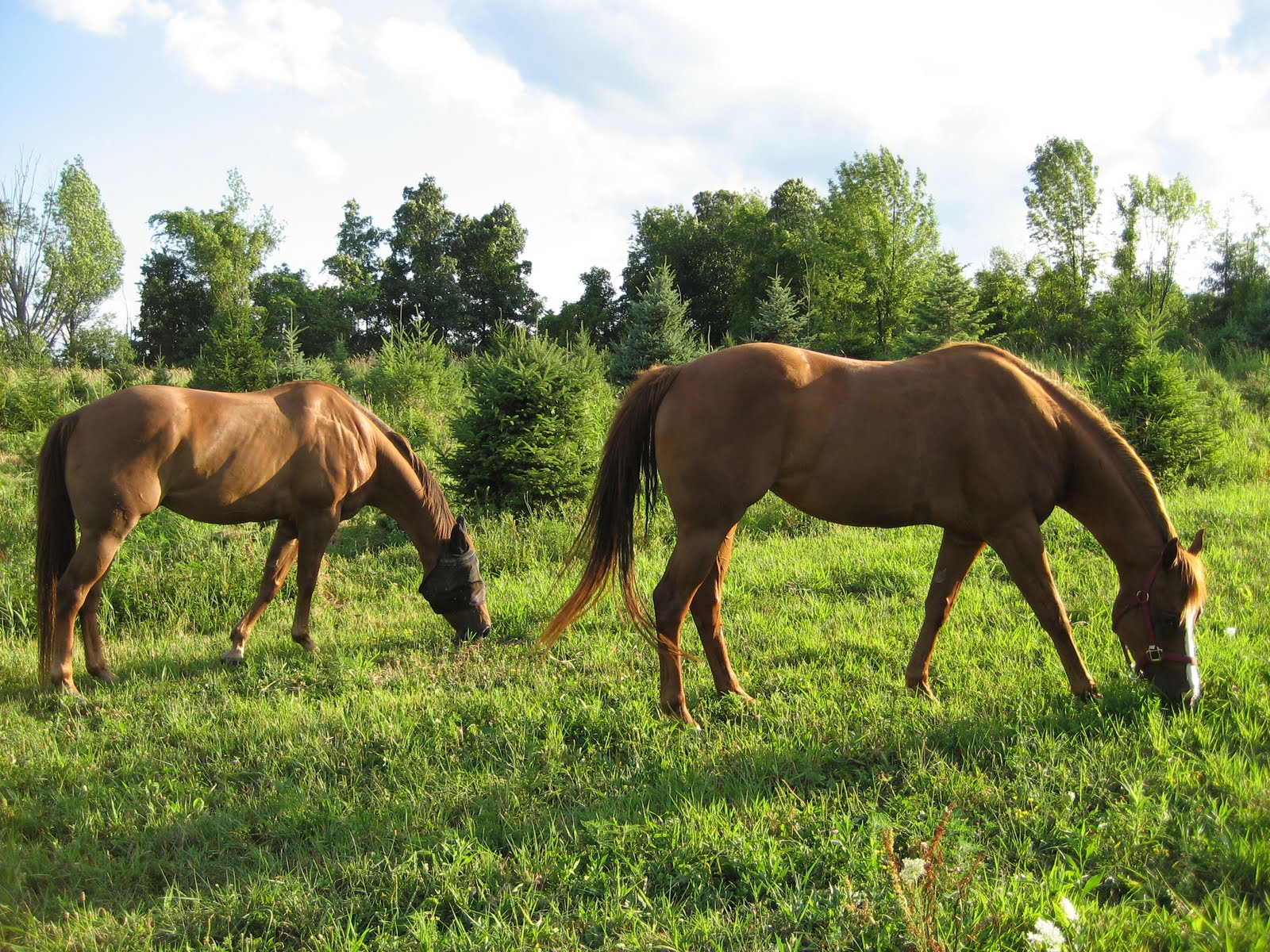
Mah ponehs- I luvs dem!
Thursday, July 28, 2011
Forward Foot Syndrome
This post is for in2paints (and anyone else who is interested): A moderator for one of the listserves I read posted this last night and I thought it was a really good explanation of forward foot syndrome and how to fix it. Walt's words are in black. You can find some more info about it on Jenny's page.
With all the rest, one additional problem all newbies to trimming face is semantics. Those of us who are used to talking "horse" and "hoof" throw terms around easily, and for the most part we understand each other -- but it takes some time to reach that condition. Some say it's almost like being suddenly dropped into the east end of London where cockney is spoken. Cockney is the nonstandard dialect of English spoken by many of the residents, who understand each other, but to those who haven't been there for long it almost sounds like a foreign language, and it takes some getting used to. Well, talking horse isn't quite like Cockney (though some of our spouses may think so). But I'll grant you that "lowering" heels and "bringing them back" at minimum sounds like a dichotomy. Just stick with it, and "horsespeak" will eventually rub off on you.
Meantime, the two primary dicta of hoof care are "bringing the toe back" and "lowering the heels". These two actions alone go far in assuring proper foot function. They are both "little things", easily accomplished, but are extremely important for proper foot function, and unfortunately, many trimmers fail to do so. I'll try an explanation without graphics -- which can be hard for both of us. As the foot continues to get little or improper trimming, the toe tends to grow long and the heel forward. The heel would actually be growing high, but the forces pulling everything forward also bend the heel tubules and bring the heels forward instead of downward. Other symptoms develop, eventually, like curvy, laid-over bars, and a long, thin, pencil-like frog. This condition is known as Forward Foot Syndrome (FFS).
Let's get to the heel -- too high / too far forward. The easy one is lowering the heels -- that means they've grown too long (but their tubules are still straight, not bent forward -- more on that in a moment). Some trimmers allow long heels in order to induce a certain "way of going" for the horse, for appearance sake while moving, mostly. Problem is, a high heel forces the coffin bone's tip to tilt downward. Coffin bone should be close to ground parallel so that the horse's weight bearing down on the sole is evenly distributed over the broad expanse of the sole. A lowered c.b. tip puts most of the weight-bearing load on the sole under the bone tip. That's got to hurt, it pinches the sole itself, and ironically, it can cause a heel-first landing which we DON'T want in this case -- because it's an attempt by the horse to ease his discomfort in the toe area. So keep the heel height down to a point where when the foot is properly balanced, the c.b. is ground parallel. Where is that point? You'll end up finding it on your own horse, but you gotta start somewhere. There is a lot written
about heel height, and several plausible methods for keeping it just right: I think a good place to start is to trim it down to the point where a healthy frog will touch ground at the same time the heel buttresses do so. If the frog isn't suitable as a reference, you can carefully scrape all the dead sole you can get to out of the Seats of Corn, and trim the heel buttresses to be on the order of maybe 1/4-inch higher than that live sole plane in the Seat.
Now how about bringing the heel back? This is a little more complicated. As FFS develops, the toe grows long, the white line actually starts to stretch around the toe, and the heel is pulled forward. But the heel starts out growing at a downward angle. It keeps on growing if not trimmed or worn, and with FFS, it makes a rather sudden direction of growth change from down to forward. From then on, it continues to grow (tubules get longer), but the direction has become forward. Consider a broom: prepare to sweep, and hold it vertical on the ground as you press downward. Because of the broom's "tubules", let's call them, being vertical and supporting each other, there is good resistance to downward pressure. That's what we want in healthy heel buttresses. Now lean the broom at an angle and continue to press straight down. The broom "tubules" now bend en masse along the ground, and there is little resistance to your pressure. That's what we DON'T want to happen to the heel tubules in an FFS foot.
So what if they do bend forward, you ask? Well, the horse still supports himself on his heels, but because the lowest point on an underslung heel (which takes the horse's weight as he moves) is not on the ends of the tubules where the strength lies (the broom analogy?), but rather somewhere part-way down the tubules, the part that's actually on the ground, where there is no supporting strength. We need to correct the condition, which can take some time. The objective is to get tubule ends in ground contact so they can do their work. Proper trimming of an underslung heel requires shaving off a little at a time -- you'll be taking off what amounts to the side of the buttress -- until you've created enough shorter tubules to begin to take the horse's weight comfortably. You cannot just rasp off all the bent-forward heel tubules.
This heel buttress repair procedure is much more complex and time-consuming than taking back the toe, but both are necessary in an FFS foot. It's a major reason for not allowing FFS to develop in the first place, and all it takes to prevent it is rendering a proper trim. At EVERY trim, take the toes back and trim the heels, even if it's just a very small amount. For maintenance trimming, you can regularly take the toe back with vertical rasp strokes, removing the outer layer between roughly 2:00 to 10:00. Remember, because of the toe angle, you're actually removing very little of outer wall layer tissue. This, together with a rocker will help keep breakover back toward the frog tip, but you're also leaving the inner wall layer intact and at full strength to help support the horse as he moves.
I know that this has been rather heavy. I hope it's clear enough for you. Don't worry too much -- this isn't rocket science, it's mostly just common sense.
Walt
Meantime, the two primary dicta of hoof care are "bringing the toe back" and "lowering the heels". These two actions alone go far in assuring proper foot function. They are both "little things", easily accomplished, but are extremely important for proper foot function, and unfortunately, many trimmers fail to do so. I'll try an explanation without graphics -- which can be hard for both of us. As the foot continues to get little or improper trimming, the toe tends to grow long and the heel forward. The heel would actually be growing high, but the forces pulling everything forward also bend the heel tubules and bring the heels forward instead of downward. Other symptoms develop, eventually, like curvy, laid-over bars, and a long, thin, pencil-like frog. This condition is known as Forward Foot Syndrome (FFS).
Let's get to the heel -- too high / too far forward. The easy one is lowering the heels -- that means they've grown too long (but their tubules are still straight, not bent forward -- more on that in a moment). Some trimmers allow long heels in order to induce a certain "way of going" for the horse, for appearance sake while moving, mostly. Problem is, a high heel forces the coffin bone's tip to tilt downward. Coffin bone should be close to ground parallel so that the horse's weight bearing down on the sole is evenly distributed over the broad expanse of the sole. A lowered c.b. tip puts most of the weight-bearing load on the sole under the bone tip. That's got to hurt, it pinches the sole itself, and ironically, it can cause a heel-first landing which we DON'T want in this case -- because it's an attempt by the horse to ease his discomfort in the toe area. So keep the heel height down to a point where when the foot is properly balanced, the c.b. is ground parallel. Where is that point? You'll end up finding it on your own horse, but you gotta start somewhere. There is a lot written
about heel height, and several plausible methods for keeping it just right: I think a good place to start is to trim it down to the point where a healthy frog will touch ground at the same time the heel buttresses do so. If the frog isn't suitable as a reference, you can carefully scrape all the dead sole you can get to out of the Seats of Corn, and trim the heel buttresses to be on the order of maybe 1/4-inch higher than that live sole plane in the Seat.
Now how about bringing the heel back? This is a little more complicated. As FFS develops, the toe grows long, the white line actually starts to stretch around the toe, and the heel is pulled forward. But the heel starts out growing at a downward angle. It keeps on growing if not trimmed or worn, and with FFS, it makes a rather sudden direction of growth change from down to forward. From then on, it continues to grow (tubules get longer), but the direction has become forward. Consider a broom: prepare to sweep, and hold it vertical on the ground as you press downward. Because of the broom's "tubules", let's call them, being vertical and supporting each other, there is good resistance to downward pressure. That's what we want in healthy heel buttresses. Now lean the broom at an angle and continue to press straight down. The broom "tubules" now bend en masse along the ground, and there is little resistance to your pressure. That's what we DON'T want to happen to the heel tubules in an FFS foot.
So what if they do bend forward, you ask? Well, the horse still supports himself on his heels, but because the lowest point on an underslung heel (which takes the horse's weight as he moves) is not on the ends of the tubules where the strength lies (the broom analogy?), but rather somewhere part-way down the tubules, the part that's actually on the ground, where there is no supporting strength. We need to correct the condition, which can take some time. The objective is to get tubule ends in ground contact so they can do their work. Proper trimming of an underslung heel requires shaving off a little at a time -- you'll be taking off what amounts to the side of the buttress -- until you've created enough shorter tubules to begin to take the horse's weight comfortably. You cannot just rasp off all the bent-forward heel tubules.
This heel buttress repair procedure is much more complex and time-consuming than taking back the toe, but both are necessary in an FFS foot. It's a major reason for not allowing FFS to develop in the first place, and all it takes to prevent it is rendering a proper trim. At EVERY trim, take the toes back and trim the heels, even if it's just a very small amount. For maintenance trimming, you can regularly take the toe back with vertical rasp strokes, removing the outer layer between roughly 2:00 to 10:00. Remember, because of the toe angle, you're actually removing very little of outer wall layer tissue. This, together with a rocker will help keep breakover back toward the frog tip, but you're also leaving the inner wall layer intact and at full strength to help support the horse as he moves.
I know that this has been rather heavy. I hope it's clear enough for you. Don't worry too much -- this isn't rocket science, it's mostly just common sense.
Walt
Subscribe to:
Posts (Atom)