Friday, February 22, 2013

The honeymoon trimester


Once you reach the 14 week mark of your pregnancy you are officially in the second trimester, and if you're lucky like I was, most of the horrible symptoms of the first trimester go away. That means no more all-day nausea and no more wish-you-were-dead exhaustion. Plus an added bonus, you can feel the little tyke move!

Around 15 weeks I started to think I could feel something in there, by 16 weeks I knew what I was feeling was baby, and by 18 weeks my husband could feel him moving around in there. Actually by 18 weeks my husband could see him moving around in there.

What does it feel like? Ask someone to come around randomly throughout the day and gently poke you right above your pelvis a few times with a finger. That's about what those first few weeks felt like to me. It is simultaneously amazing and super creepy. Or maybe I've seen too many sci-fi movies...

Unfortunately though, the second trimester of pregnancy brings it's own problems. For me, problem #1 was round ligament pain. Normally this is a sharp groin pain that most women feel when standing up or rolling over or something similar, it normally lasts for a few seconds and then it's gone. Well, let me tell you something my fellow riding friends: The stronger the muscles of your pelvic floor the worse you'll feel round ligament pain. Know what makes your pelvic floor muscles really, really strong? Horseback riding, especially dressage. Yay. So one Sunday morning, as I was trying to make myself breakfast, I ended up on the floor gasping and crying from intense groin pain that didn't quit for 10 minutes (my poor husband had decided to throw me in the car and take me to the hospital when it finally let up). When I called my doctor's office the next day, the nurse said that was normal. "But it put me on the floor!" I said. "Totally normal," she replied.

Uh huh, not acceptable. So I did some internet searching and found a website called Spinning Babies that had some exercises for stretching out those muscles and ligaments that were killing me. The first one is called the Inversion, it looks absolutely bonkers but it helped SO MUCH! It takes your head a few days to get used to it, but the stretch on my ligaments started to help immediately. If you can, keep this up during the rest of the pregnancy, not only is it a good stretch but it also helps get the baby head-down for birth.


Helpful exercise #2 were the pelvic tilts, these not only help stretch the pelvic floor muscles and ligaments but also stretch your lower back nicely in the third trimester. Feels SO good!
let the belly hang
tilt your pelvic toward your chin and round your back
 And finally, another exercise I couldn't do without, the Bird Dog exercise. These are for when your back starts to hurt and pain starts shooting down your legs. Give it a few days to a week to start working, but it will help the pain go away. This can be done in the third trimester, balancing becomes hard but not impossible.

 
After I started doing these exercises, the second trimester was a breeze for me. I even went for a few rides, much to Coriander's chagrin. Here's another tip: When you're six months pregnant, canter in two-point/half seat. Trust me on this.

At this point I've still got a month to go. We're almost ready to meet our little guy!

Thursday, February 14, 2013

Another barefoot article

 This one is from Eurodressage, "Keeping Horses Barefoot: A healthy horse from the ground up." Once again, Shannon Peters is quoted as a barefoot advocate (because Shannons are good people), they've also got a few quotes from veterinarian Melanie Quick who astutely advises that horse owners do their research before taking their horses barefoot. She also says this, which makes me happy:

“I prefer horses living the barefoot lifestyle, as there is absolutely no doubt that when applied correctly it gives the horse superior hoof, leg and back health, enhanced soundness, increased career longevity, and optimizes their performance. If the competition rules can be changed to allow hoof boots in the dressage arena I think barefoot will be massive, and we will all wonder why anyone ever shod a horse.”

Yes, thank you Dr. Quick for saying it and thank you Eurodressage for printing it.

But then there are some other quotes that make me want to pull my hair out. Like this one from FEI Dressage Director Trond Asmyr, "the reason why hoof boots are not allowed in FEI Dressage events is because they may be masking potential unsoundness and it is the FEI’s policy to ensure that all horses taking part in FEI events are perfectly sound and fit to compete. There are therefore no plans to change this rule."

Seriously? Because shoes don't do the same thing? How many of us know of a horse that was not sound barefoot become "sound" as soon as a set of shoes was nailed on? Everyone? Your argument is invalid, Mr. Asmyr.

Just to clarify my position in this argument: If a horse is not sound totally barefoot then the horse isn't sound no matter how they go in boots or shoes.

Then there's this from farrier Michael Jakob that sets me a little on edge: "According to Jakob there are also various reasons why the horse may seem lame lame after a barefoot trim, but he says the main problem could be that the hooves are cut too short."

This bothers me because it's a gross oversimplification of why a horse would be lame after a trim. I suppose I should give the guy a break since this is a magazine article and he can't go into detail about what might be causing a horse pain, BUT here's what really bothers me about that quote: it puts the blame onto the shoulders of the trimmer without consideration of the health (or lack of) in the hoof being trimmed.

I'm planning on writing a blog post about this (eventually), but here's something everyone should know: If a hoof is really unhealthy, it cannot be returned to health without some level of discomfort. If someone tries to tell you otherwise, they either don't know what they're talking about or they're lying to you.

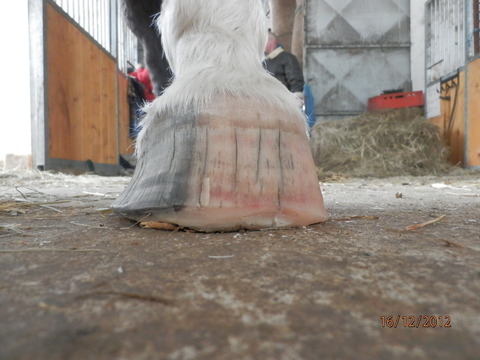
And then there's this, the hoof they used as an example in the article:

Now I know I'm being overly critical, but darn it, I have high standards. The heels are uneven, the bars are too long and edging towards impacted (That crack in the frog where thrush likes to live? Goes hand in hand with bars that are too long.), and the hoof wall connection is poor. Oh, and can you see the toe creeping forward? This horse is landing toe first because the bars make the back of the hoof uncomfortable.

Well, it's still progress. Head on over to Eurodressage and read the article when you get a chance.

Friday, January 25, 2013

Barefoot article in Dressage Today

Hi all, I ran across a link to this article today and wanted to get it out to anyone who wants to read it:

Beyond the Horseshoe

Read all about how Olympic dressage horse, Ravel, and score of other horses in Steffen and Shannon Peter's care are now barefoot. For free!


Sorry I haven't written much lately, for once in my life horses aren't at the forefront of my mind. The Quarters are doing well, though they aren't doing much more than eat hay while we wait for this arctic blast to blow by. There are some things I want to write about, I'll try to muster up the energy to do that sometime soon. Until then take care and stay warm!

Thursday, January 3, 2013

Winter shows her snowy face

Gwen is too busy for photos

But Coriander knows I've got food in my pocket

I know there's grass under here!

Gwen is annoyed with snow

But Coriander doesn't seem to mind

Butch prefers to eat out of the feeder

But my two like their bags :)

Sunday, December 30, 2012

When the 'celery approach' doesn't work

Isn't it nice that the world didn't end last week? Now I can get back to discussing the hooves from my last post. Many of you caught on to my bit of sarcasm about the truly awful state those hooves have fallen into, this is what happens when the 'celery approach' goes bad.

So much wrong here...
For those of you who may not know, the celery approach is advocated by Nic Barker of Rockley Farm, the author of "Feet First: Barefoot Performance and Hoof Rehabilitation." Barker believes that people shouldn't touch horse hooves with anything sharper than a stick of celery; that all modification of the hoof should be done by self-trimming alone.

Let me just be clear on one point: I have a lot of respect for Nic Barker and what they do at Rockley Farm. I am inspired and impressed by what they achieve and many of the things Nic writes about leave me thinking. But I think their blog should come with a disclaimer: Do not try this at home without doing your research.

The celery approach works for the folks at Rockley because they've put a lot of time, effort and resources into creating an environment and lifestyle where the horses can self-trim their way to soundness. From what I've seen and read, they have three key pieces in place for this to happen.

  1. A day-to-day living environment on very abrasive footing. 
  2. A very specific and controlled diet.
  3. An extensive daily exercise regimen that is, again, done on very abrasive footing.
If you want to embrace the celery approach to hoofcare, more power to you, just be prepared to spend a lot of time and money making sure your horse is living a lifestyle that will enable that. There is a reason that people have been using hand tools to trim hooves for hundreds of years, most domesticated horses don't get enough exercise on a variety of surfaces to wear down their own hooves, and overgrown hooves create a mess of problems.

I mean, seriously, how does she even function?
*I did contact the owner of the horse from my last post and sent her an eight page document detailing what I saw going on with those hooves and a plan for bringing them back to health. Fortunately she agreed with what I said and I'm going to work with her over email to see if we can't get her horse sound again (he currently most definitely is NOT). Fingers crossed.*

Friday, December 21, 2012

Hooves for the end of the world

I snagged these photos from an online barefoot trimming group. It was recommended to the owner a few months ago to stop trimming the horse (he had been sore after a trim) and just to let the hooves grow. Here they are a few months later. What do you think? Chalk this up as another win for the "celery" approach?

(You'll see some pictures where the hooves have been touched with a rasp- we'll just ignore that for now.)


BTW- happy winter solstice!

Wednesday, December 19, 2012

More on pregnancy: A few details I missed

In my last post I wrote about some of the lovely symptoms a woman may encounter during the first trimester of pregnancy. I realized a bit later that I missed a few things, mostly the side effects that are just annoying in the beginning but don't go away after the first trimester. Nope- they just get more obnoxious.

The breathing
You may not be aware of this, but pregnancy hormones also affect your lungs, increasing their capacity. What this means is that you might start breathing a bit heavier when you become pregnant. Or you may be like me and end up breathing A LOT heavier really early on. Seriously, I'd climb one flight of stairs and I'd be breathing like I'd just run a mile. I wasn't tired, I wasn't out of breath, but boy did I sound like I was. I was walking across campus with a coworker one day when she asked me if I wanted to slow down, "what, why?" I asked.

"Because it sounds like you're dying," she said. Oh.

Of course later on you start having issues breathing because you've got a baby kick-boxing your lungs. But that's for later.

The gas
When you get pregnant your hormones will also affect your digestive system, slowing the whole business down. When this happens you start to accumulate gas, which then needs to come out. Pregnant women start to sound a bit like one-person bands. One day, after burping for the umpteenth time after drinking orange juice I turned to my husband and said, "I burp after drinking orange juice, who does that?"

"My grandfather," he said. Excellent.

Fortunately for everyone around me, my gas tends to come out of my mouth, some aren't so lucky. When we got married, the best man's wife was pregnant and she stayed in our spare bedroom for the night before the ceremony. When we came back from our honeymoon a week later, the stench in that room was still bad enough to make your eyes sting. True story.

The peeing 
Even if you've never been pregnant, you've probably heard about how preggos frequently need to urinate. You might think that starts later in the pregnancy when the baby gets big enough to start pressing on your bladder, but no, it starts immediately. Sure, in your first trimester you'll probably only need to pee once every two hours instead of the once every half hour/10 minutes/5 minutes that you'll experience later in the pregnancy, but even peeing every two hours gets a little annoying. Given this you might be tempted to drink less, but that is not a good idea. First of all, you'll feel terrible if you don't drink, your body wants that fluid for a reason. In the first trimester you're building the placenta- which is filled with amniotic fluid, and you do not want your amniotic fluid levels to be low. Also, your blood volume doubles and water is pretty necessary to that process too. So drink up ladies, and stock up on toilet paper!

Fortunately you probably won't pee yourself in the first trimester. Nope, that bit of fun is saved for the second and third trimesters. Joy!

Laugh it up now, dude, the mood swings are coming for you...